The core architectural elements of a RESTful system
Elements of a RESTful system
Analogous to any software architecture, the REST architecture is also defined by a configuration of key architectural elements (components, connectors, and data) with a set of constraints, as shown in the following diagram:
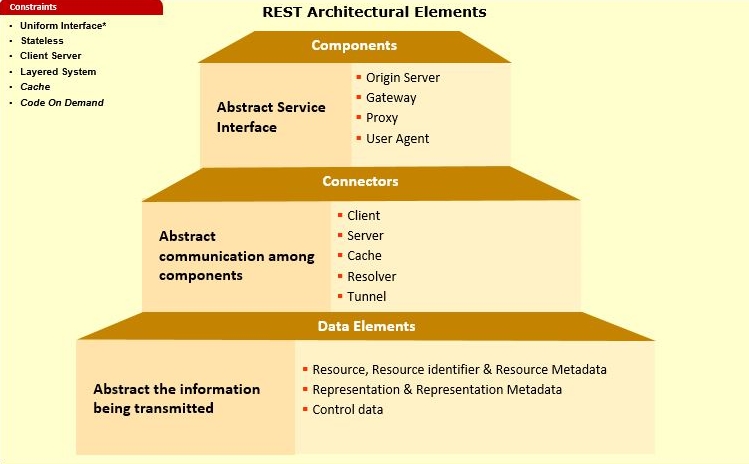
Data elements
The central feature that distinguishes the REST architectural style from other network-based styles is its emphasis on a uniform interface between components, which abstracts the information being transmitted. A uniform interface is fundamental to the architecture of any RESTful system. In plain words, this term refers to a generic interface to manage all interactions between a client and server in a unified way. All resources (or business data) involved in the client-server interactions are dealt with a fixed set of operations. The following are the core elements that form a uniform interface for a RESTful system:
- Resources and their identifiers
- The representation of resources
- Generic interaction semantics for the REST resources
- Self-descriptive messages
- Hypermedia as the engine of an application state
Resources
A RESTful resource is anything that is addressable over the web. By addressable, we mean resources that can be accessed and transferred between clients and servers. Subsequently, a resource is a logical, temporal mapping to a concept in the problem domain for which we are implementing a solution.
Here are some examples of REST resources:
- A news story
- The temperature in NY at 4:00 p.m. EST
- A tax return stored in the IRS database
- A list of code revision history in a repository such as SVN or CVS
- A student in a classroom in a school
- A search result for a particular item in a web index, such as Google
Even though a resource's mapping is unique, different requests for a resource can return the same underlying binary representation stored in the server. For example, let's say we have a resource within the context of a publishing system. Then, a request for the latest revision published and the request for revision number 12 will at some point in time return the same representation of the resource. In this example, the last revision is version 12. However, when the latest revision published is increased to version 13, a request to the latest revision will return version 13, and a request for the revision of version 12 will continue returning version 12. This implies that in a RESTful architecture, each resource can be accessed directly and independently, and sometimes, different requests may point to the same resource.
As we are using HTTP to communicate, we can transfer a variety of data types between clients and servers, as long as the data type used is supported by HTTP. For example, if we request a text file from CNN, our browser receives a text file. If we request a Flash movie from YouTube, our browser receives a Flash movie. The data is streamed in both cases over TCP/IP and the browser knows how to interpret the binary streams because of the Content-Type header present in the HTTP response header. Following this principle, in a RESTful system, the representation of a resource in the response body depends on the desired internet media type, which is specified within the request header sent by the client.
URI
A URI is a string of characters used to identify a resource over the web. In simple words, the URI in a RESTful web service is a hyperlink to a resource, and it is the only means for clients and servers to exchange representations.
The client uses a URI to locate the resources over web, sends a request to the server, and reads the response. In a RESTful system, the URI is not meant to change over time as it may break the contract between the client and server. More importantly, even if the underlying infrastructure or hardware changes (for example, swapping the database servers) for a server hosting the REST APIs, the URIs for the resources are expected to remain the same as long as the web service is up and running.
The representation of resources
The representation of resources is what is sent back and forth between clients and servers in a RESTful system. A representation is a temporal state of the actual data located in a storage device at the time of request. In general terms, it is a binary stream, together with its metadata, which describes how the stream is to be consumed by the client. The metadata can also contain extra information about the resource, for example, validation, encryption information, or extra code to be executed at runtime.
Throughout the life of a web service, there may be a variety of clients requesting resources. Different clients can consume different representations of the same resource. Therefore, a representation can take various forms, such as an image, a text file, an XML, or a JSON format. However, all clients will use the same URI with appropriate Accept header values for accessing the same resource in different representations.
For the human-generated requests through a web browser, a representation is typically in the form of an HTML page. For automated requests from other web services, readability is not as important, and a more efficient representation, such as JSON or XML, can be used.


Comments
Post a Comment